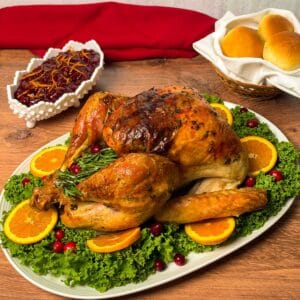
Herb-Roasted Turkey
Herb-roasted turkey is an easy, delicious way to prepare a juicy, golden-brown turkey for your special holiday occasions. It's made with a simple herb butter with fresh rosemary, thyme, and sage. This easy-to-make oven-roasted turkey is full of flavor and is sure to impress.
Equipment
- Large Roasting Pan (See Tip 1)
- Cooking thermometer
Ingredients
Herb Butter
- ½ cup (1 stick, 4 ounces, 113 grams) unsalted butter
- 1 Tablespoon fresh rosemary, finely chopped
- 1 Tablespoon fresh thyme leaves, chopped
- 1 Tablespoon fresh sage, chopped
- ½ teaspoon freshly ground black pepper
Herb Roasted Turkey
- 12 pound frozen Butterball turkey, fully thawed
- Herb butter from above
- 1 medium onion, peeled and quartered
- 2 stalks of celery, cut into 2 to 3 inch pieces
- Several sprigs of fresh rosemary and thyme
- ½ cup (4 ounces, 113 grams) water
Instructions
Herb Butter
- Combine the softened butter, rosemary, thyme, sage, and black pepper in a small bowl. Mix thoroughly. Set aside.
Herb Roasted Turkey
- Preheat the oven to 350°F. Position the oven rack in the lower third of the oven. Remove the neck and giblets from the fully thawed turkey. (See Tip 2)
- Make a simple sling to easily remove the turkey from the roasting pan by tying the ends of a piece of cooking twine that is at least 46 inches long together. Lay the sling across the roasting pan. (See Tip 3)
- Tuck the turkey wings under the turkey, place it on the sling in the roasting pan, and position the sling under the legs and wings. Pat the turkey dry with paper towels.
- Gently loosen the skin over the turkey breast without tearing it. Spread approximately ⅔ of the herb butter under the skin, distributing it evenly over the breast. Rub the remaining butter over the outside of the turkey. (See Tip 4)
- Place the quartered onion, celery, and fresh herb sprigs loosely inside the turkey cavity. Pour ½ cup of water into the bottom of the roasting pan.
- Roast the turkey, uncovered, in the preheated 350°F oven for approximately 2 ½ to 3 hours. Begin checking the internal temperature after about 2 ½ hours. If the skin becomes too brown, loosely tent the turkey with aluminum foil.
- The turkey is done when a food thermometer registers at least 165°F in the thickest part of the breast and the innermost part of the thigh. (See Tip 5)
- When done, remove the turkey from the oven and transfer it to a carving board or serving platter. Allow to rest for at least 30 minutes before serving. (See Tip 6)
- Yield: 8 servings (See Tip 7)
Video
Tips/Notes
- I used a large roasting pan, but you could also use a disposable aluminum roasting pan.
- If desired, use the giblets for giblet gravy.
- Be sure to use food-grade cooking twine.
- This is the messy part of making this recipe!
- I like to cook the turkey a bit more once it reaches 165°F. The reason is that at 165°F, the joints can still look a bit reddish. I actually cooked this turkey to 194°F. This is a personal preference.
- Many recipes will indicate that you should tent the turkey with aluminum foil when it's removed from the oven. My preference is to skip the tenting. The reason is that tenting tends to soften the crisp skin. This is a personal preference.
- Consider making sliders, casseroles, or soup with the leftovers.
Nutrition
Calories: 790kcalCarbohydrates: 0.5gProtein: 154gFat: 16gSaturated Fat: 5gPolyunsaturated Fat: 3gMonounsaturated Fat: 4gTrans Fat: 0.2gCholesterol: 463mgSodium: 803mgPotassium: 1612mgFiber: 0.2gSugar: 0.5gVitamin A: 341IUVitamin C: 1mgCalcium: 85mgIron: 6mg
Tried this recipe? Add me to Google's Preferred Sources above.
